Which Degrees Prepare Graduates for High-Demand Jobs?
By Lainey Stalnaker, Data Analytics Writer

LMI recently released its second Supply Gap Analysis, which evaluates the extent to which South Carolina’s educational institutions (both secondary and post-secondary) are able to meet employer demand for workers. If an occupation has a significant supply gap, then it is likely experiencing very high demand. In this article, we’ll take a look at the degrees that are most common among workers in these high-demand occupations.
Among occupations requiring a post-secondary credential, those with the largest supply gaps were:
- Registered Nurses (3,160)
- Heavy and Tractor-Trailer Truck Drivers (2,400)
- Medical and Health Services Managers (1,760)
- Securities, Commodities, and Financial Services Sales Agents (1,200)
- Computer User Support Specialists (1,070)
- Software Developers (1,070)
- Human Resources Specialists (1,050)
- Management Analysts (1,020)
- Business Operations Specialists, All Other (1,020)
- Bookkeeping, Accounting, and Auditing Clerks (820)
The highest-demand jobs mostly fit into one of three categories: healthcare, computer, and business occupations. Healthcare and computer occupations tend to be aligned with their respective degree programs. For example, 86 percent of registered nurses held a degree in registered nursing. About 75 percent of medical and health services managers had a healthcare or biological sciences degree, with registered nursing again being the most common. Similarly, 79 percent of software developers and 73 percent of computer user support specialists had a degree classified under computer and information sciences and support services.
The path to a career in business management or administration, however, is often less clear. A wide variety of educational programs can prepare a person for a career in business—including some that you might not expect.
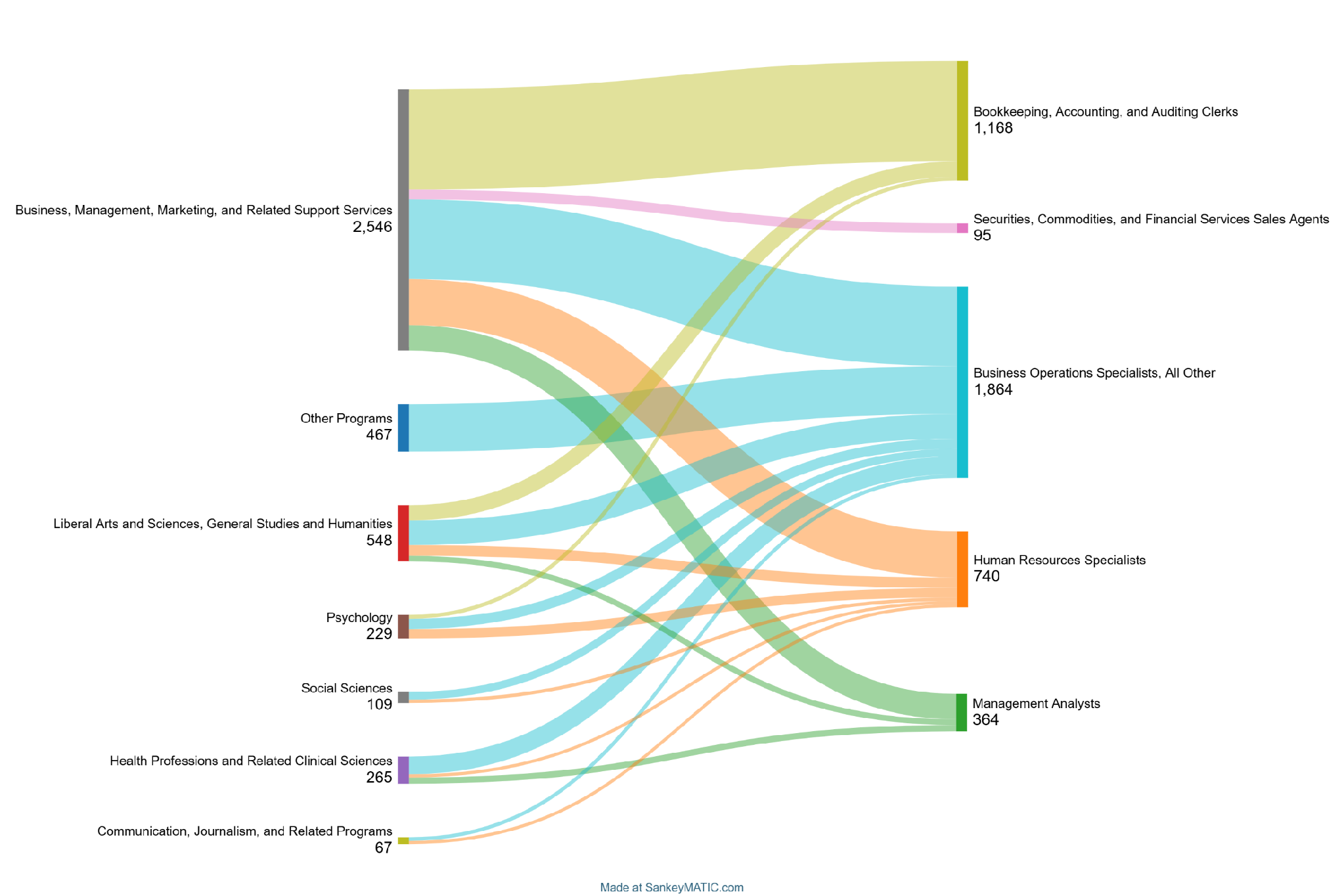
The figure below shows the most common degree types among workers in the five most in-demand business occupations. Unsurprisingly, people working these jobs were most likely to hold a degree in business, management, marketing, and related support services; however, the second most common degree type was liberal arts and sciences, general studies and humanities. A total of 239 liberal arts graduates were observed working as business operations specialists. An additional 150 were working as bookkeeping, accounting, and auditing clerks while 103 worked as human resources specialists, and 56 as management analysts. Other common degrees included health professions and related clinical sciences; psychology; social sciences; and communication, journalism, and related programs, among others.
While some degrees are more rigidly connected to employment in a single occupation, others open the door to a multitude of career paths. Check out the previous installment in our series for more information on degrees that can lead to a variety of careers. Coming soon, we’ll take a closer look at a subset of those degrees—humanities and social sciences.