What Jobs Can You Do with a Humanities Degree?
By Lainey Stalnaker, Data Analytics Writer

Most people attend college with the hope that a degree will help them secure a job, but degree programs vary immensely in their content and applications, and some provide a much more predictable path into the workforce than others.
For example, certain healthcare degrees provide an obvious path to a job. Nursing students tend to become nurses; dentistry students tend to become dentists, and so on. This makes sense—these occupations usually require a highly specialized skillset, and as a result, they require educational credentials that are specific to the job, with a narrow range of applications.
Many instructional programs can be characterized this way—architecture, engineering, mechanic and repair technologies—but what about less technical areas of study, like humanities and social sciences? Where do these graduates end up in the workforce? Using graduation records along with our enhanced wage records, we can identify exactly which occupations these individuals are working in.
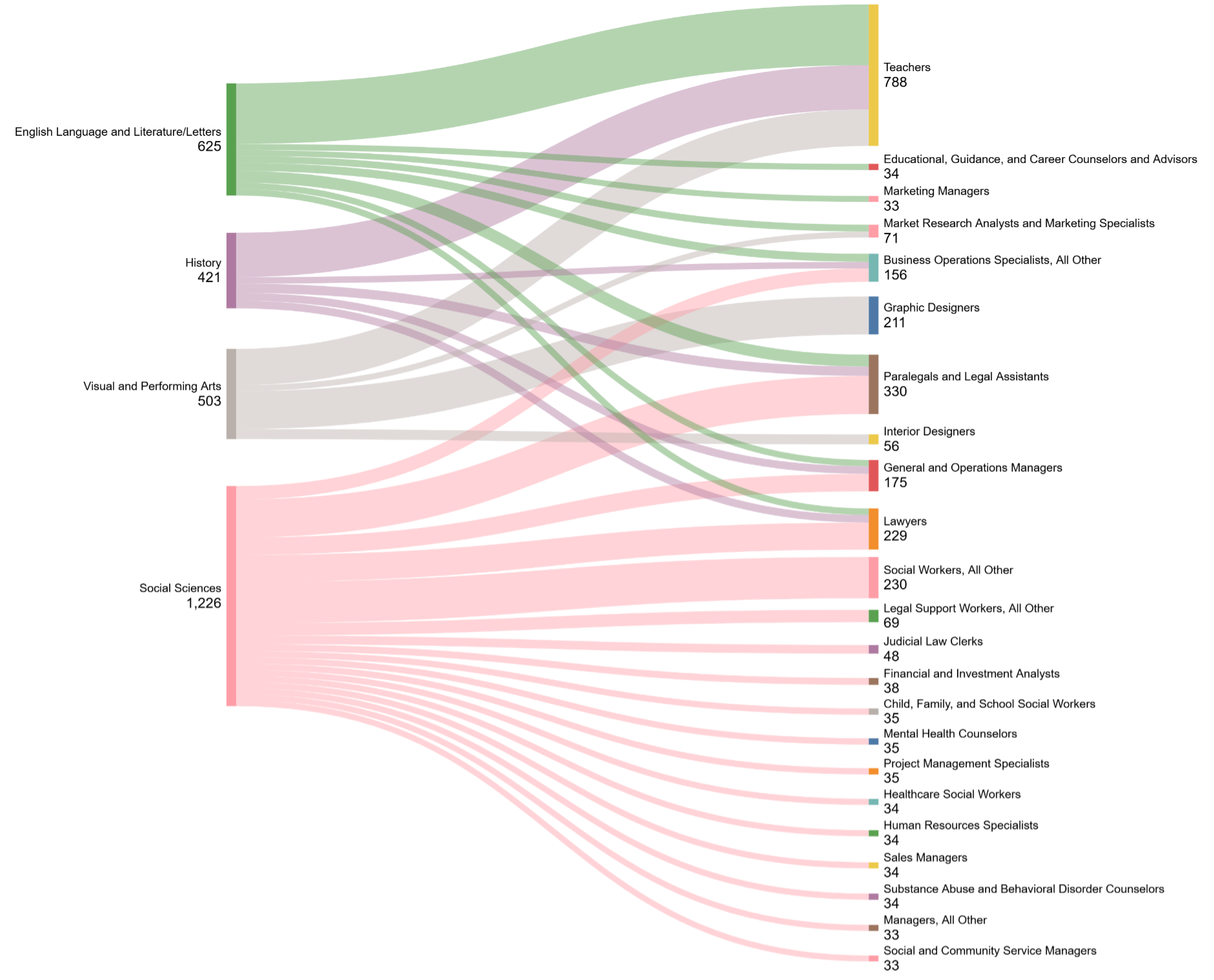
The figure below shows the most common occupations of employment for graduates of English language and literature/letters; history; visual and performing arts; and social sciences programs.
Teaching was the most common profession for both English literature and history graduates, and it was the second-most common profession for visual and performing arts graduates; however, this was certainly not the only option for humanities students. Legal professions such as lawyers and paralegals were common. Graphic design was a popular career choice for visual and performing arts students, while social sciences graduates frequently entered social work and other community and social services professions.
Business management and administration also proved to be a viable career path for humanities students, who were commonly found in marketing, management, and business operations occupations.
Overall, a humanities degree may not provide as obvious a path into the workforce as other degree types, but it can prepare students for a wide range of possible careers, teaching skills that can be transferred across occupations and industries.
Figure 1. Most Common Occupations of Employment Among Humanities and Social Science Degree Graduates